
We've Had it Since the American Revolution
Dear Leading Ladies,
I walked into our little post office a few days ago to buy some stamps and asked our postmaster if the recent presidential order regarding mail-in voting had yet affected his work. He said, no, luckily, not yet. As I walked out, I thought how extraordinary it was that I was almost haphazardly asking a federal employee if he was going to be forced to collude in possibly preventing some legally registered voters from casting their ballots. How extraordinarily indeed. What have we become inured to, started to take in stride, stopped being appalled by?
Moreover, I realized I didn’t even really understand either the history of mail-in voting or the impact of the attempted latest presidential overreach. And if I was so ignorant, there must be many others in my place.
Why does the president care so much about the USPS?
The president clearly wants to use the USPS as a major player in his quest to control our elections. As a recent New York Times article points out, restricting absentee voting works to his benefit because Democrats utilize the opportunity more frequently. If he is permitted, the president will activate the Department of Homeland Security to go through the voter rolls to find non-citizens.
As of last Friday, a federal judge extended the prohibition against the USPS implementing the president’s “executive order seeking to limit mail voting during the midterms,” according to the Times. This occurred just as states such as North Carolina were starting to mail out their ballots. The president’s administration will appeal this decision to the US 1st Circuit Court of Appeals, after appealing the last temporary order to the Supreme Court.
Some predict the president’s efforts are too late to affect the upcoming midterms and will never succeed. We think we’d be ill-served by never saying never.
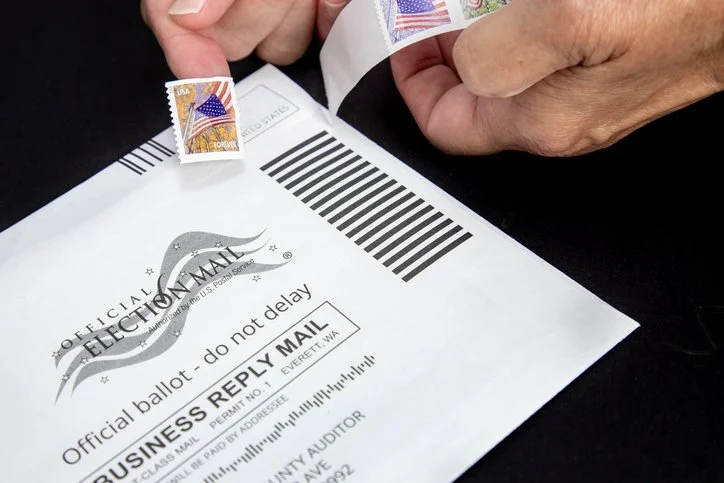
Credit: istock
What is the history of absentee voting in the US?
According to the Smithsonian, "Early approaches to voting by mail in the U.S. enabled military service members to participate in elections when wartime deployments took them away from their polling precincts." It was first recorded during the War of 1812 and became prevalent during the CIvil War, when “most of the states in the Union granted absentee voting for its military service members in time for the 1864 presidential race between incumbent Republican Abraham Lincoln and Democratic candidate George McClellan.” For this election, “Union soldiers voted in camps and field hospitals, under the supervision of clerks and state officials,” Olivia B. Waxman wrote in Time Magazine.
Waxman places the beginning of voting by mail in the U.S. even earlier than the War of 1812 or the Civil War. The examples of absentee voting, she avows, can be traced to the Colonial era when “Men could vote from home if their homes were ‘vulnerable to Indian attack,’ according to historian Alex Keyssar’s book, The Right to Vote: The Contested History of Democracy in the United States, and the votes of some Continental Army soldiers were presented in writing ‘as if the men were present themselves’ in Hollis, NH, in 1775 during the American Revolution.”
After the Civil War, absentee or mail-in voting, the terms being used somewhat synonymously, continued and expanded to include those in professions that required them to be away from home for reasons other than military service, such as traveling salesmen and railroad workers. Waxman noted that, at the 1917-1918 Massachusetts Constitutional Convention, a delegate argued for accommodating those who are away from home on Election Day, “toiling and sacrificing for the common good,” just as soldiers do, according to Waxman.
In the years that followed, it became legal to vote by absentee ballot for illness and eventually just by choice. California, in 1978, became the first state to remove any barriers to voting by mail. Oregon was the first entirely mail-in federal primary election state in 1995 and several have followed. At least 29 states now have no-excuse mail-in voting. Amidst claims of fraud, MIT analysts determined that only 0.00006% of the 250 million votes by mailed ballots nationwide were, in fact, fraudulent in 2016.
Who actually should have authority over the USPS?
The Brookings Institution offers a short and concise history of the US Postal Service and its intended independence from the president. “The Second Continental Congress appointed Benjamin Franklin as the first Postmaster General in 1775. The Post Office Department was created in 1792 and became a Cabinet department in 1872. In 1971, Congress replaced the Department with the United States Postal Service, an independent entity within the executive branch. USPS is operated by an 11-person Board of Governors (which resembles the board of directors of a public corporation) – the Postmaster General, his deputy, and nine governors appointed by the President and approved by the Senate for seven-year terms. The Board appoints the Postmaster General, who acts as the CEO.”
(For a more complete and very interesting history of the USPS and the role it played in the American Revolution and the growth of our nation, go here.)
For our purposes, what is important to note is that the Postal Service was designed to be independent, but the current president, yet again, has found a workaround. Of the nine governor spots, at least four are vacant. Those that are filled are two Democrats, two Republicans, and one Independent. A few weeks before he filed his executive order to restrict mail voting, he filed four nominations for vacancies on the USPS Board of Governors. There is a longstanding practice of nominating governors in bipartisan pairs. Trump eschewed that policy and nominated all Republicans, three of whom have expressed doubt about the 2020 election results, according to the New York Times. The Times predicts that two are on a fast track for confirmation by the Senate when it returns to session this month.
In other words, just as with the Supreme Court, another entity that is supposed to remain nonpartisan, the USPS is becoming controlled by the administration, its independence wrested from the people.
Lessons from Jaime Raskin
In a recent appearance for Force Multiplier, US Rep Jaime Raskin, a Constitutional scholar, warned that after the years of the present administration have passed, there will be many years of repair to follow. The current administration has demonstrated the holes in our system, the checks and balances that didn’t protect us as well as they have in the past. New challenges can demand new solutions.
Did you really think we could end without a word from Gloria Steinem, another icon and sage we lost just days ago?
“Remember, the Constitution doesn’t begin with ‘I, the president.’ It begins with, ‘We, the people.’”
Judy (she/her/hers)
Therese (she/her/hers)
Didi (she/her/hers)
Leading Ladies Executive Team
Leadingladiesvote.org
ladies@leadingladiesvote.org