
Grim Fairy Tales
Dear Leading Ladies,
As we read the president’s postings last week, from the plan to rename Lake Ontario to Lake America and the state of New Mexico to New America, to a map of Iran with an image of himself overlaying it, to AI-generated images of himself with George Washington and as various comic characters, including the Green Lantern and Starship Troopers, reportedly created to be reminiscent of Nazis, we couldn’t help but be struck by the craziness of it all.
Not just the unseemly, unpresidential, and just plain nuts behavior of the president, but the reactions — or, rather, lack of reactions — from his followers who know better.
Immediately, the story of The Emperor’s New Clothes came to mind. In Hans Christian Andersen’s tale, a foolish and vain leader is swindled by two men who promise to make him a magical and invisible suit which he stupidly thinks he is wearing as he walks among his people. No one will tell him the truth — that he is walking naked among them!
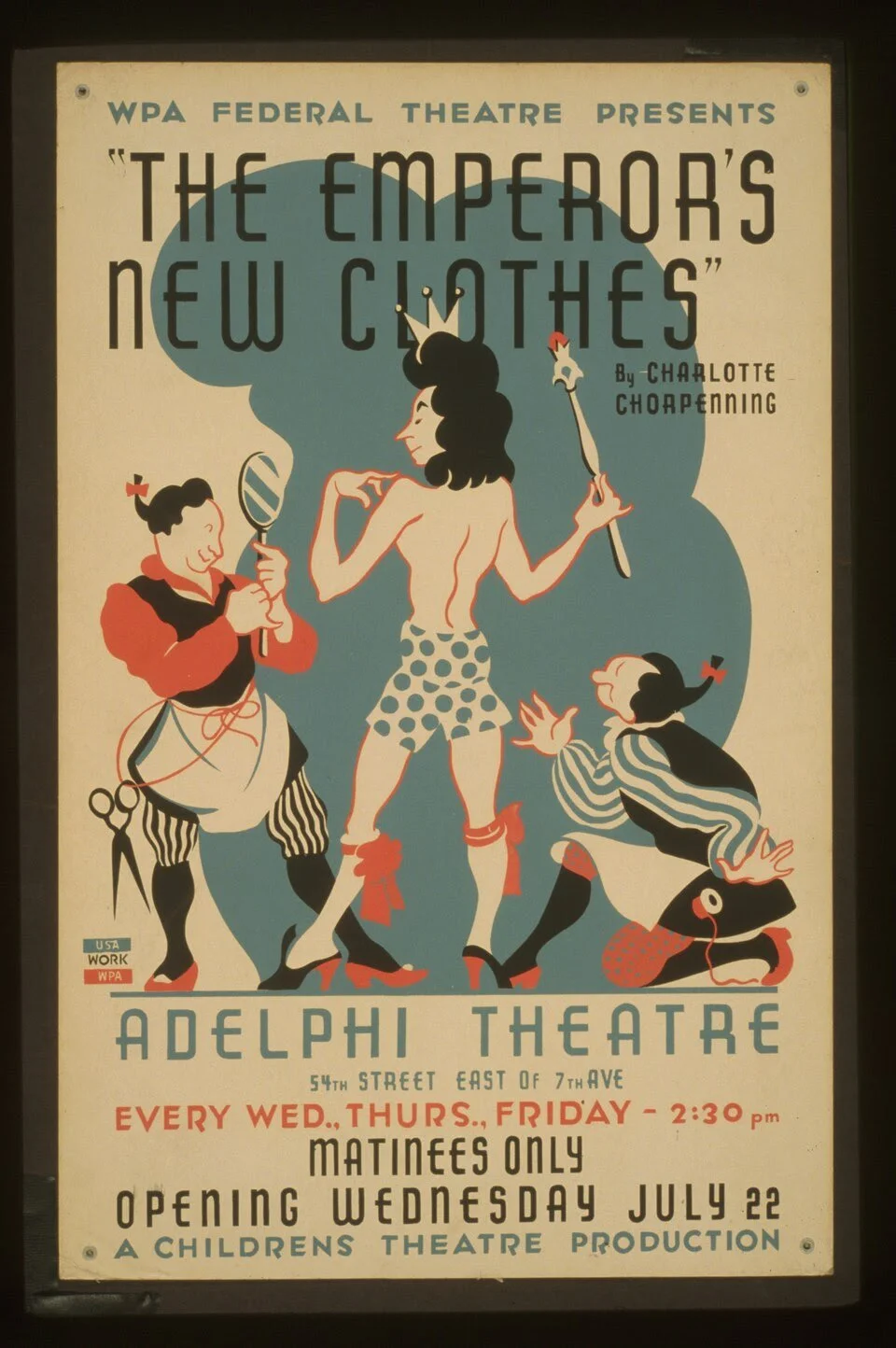
WPA Federal Theatre presents “The Emperor's New Clothes” by Charlotte Chorpenning. Work Projects Administration Poster Collection, Public domain, via Wikimedia Commons.
Andersen’s story is only one of many cautionary tales written to teach children about the pitfalls of greed and avarice, vanity and selfishness. Perhaps they should be on the bedside tables of some senators, representatives, and voters for nighttime reading in the coming days.
With the help of Google, we found these stories with similar lessons to spread.
Yertle the Turtle by Dr. Seuss tells the story of the turtles on the island of Sala-mon-Sor who were happy until their king, Yertle “[d]ecided the kingdom he ruled was too small. ‘I’m ruler,’ said Yertle, ‘of all that I see. But I don’t see enough. That’s the trouble with me. With this stone for a throne, I look down on my pond But I cannot look down on the places beyond. This throne that I sit on is too, too low down. It ought to be higher!” he said with a frown. “If I could sit high, how much greater I’d be! What a king! I’d be ruler of all I could see!”
Yertle ordered the other turtles to stack themselves up so he can use them as a throne and exert more power. Eventually, a small turtle at the bottom burps, shaking the tower and sending Yertle tumbling into the mud, upending his quest for more power.
In The King's Stilts, also by Dr. Seuss, King Birtram is generally a good ruler, though his intense fixation on his stilts makes him vulnerable. A malicious minister named Lord Droon steals the stilts, causing the king to sink into a deep depression and neglect his duties. Without his leadership, the kingdom is nearly destroyed by a flood of carnivorous birds called Nizzards. The tale points to the need for leaders to balance their personal desires with their responsibilities and their pride with the needs of their community.
One Grain of Rice, a mathematical folk tale retold by Demi: In this traditional tale set in India, a clever peasant tricks a self-important raja who hoards rice, exposing foolish leadership through math and cleverness.
If we can teach little ones lessons about good behavior and wise leadership, can’t we give a go at adults? Read someone you know one of the above titles if you think they might benefit from hearing it. While you’re at it, be sure to read to your wee ones at home, and even your not so wee ones. We need palatable lessons on good and sane behavior to remind us what we need and what is reasonable for us to expect.
Therese (she/her/hers)
Judy (she/her/hers)
Didi (she/her/hers)
Leading Ladies Executive Team
Leadingladiesvote.org
ladies@leadingladiesvote.org