
Our Constitution on its Birthday
Dear Leading Ladies,
Jill Lepore, Harvard professor, New Yorker staff writer, historian, and author, spoke at Tufts University last week, her alma mater, to an audience of mostly senior citizens with a smattering of students. Billed as a free event, open to the public and sponsored by the Solomont Speakers Series of the Tisch College of Civic Life, one might have expected more students to attend the one-hour event featuring the renowned professor of American history and law discussing her new book, We the People: A History of the U.S. Constitution.
Instead, the audience mirrored what we witnessed at the No Kings protest two days earlier. Are too many young people still not as alarmed or as engaged as we wish they were? The work of David Hogg and his Leaders We Deserve notwithstanding, there continues to be much work to be done to get our younger folks committed to change.
The composition of the audience became more relevant as we listened to Lepore speak about the necessity of people regaining power by amending the Constitution, an effort that requires either war or big social change. She calls for the need for education about political inquiry to begin as early as kindergarten to develop the democratic skills necessary to amend the Constitution by means other than insurrection and revolution. She sees great value in grass roots efforts and directed the audience to groups such as Braver Angels.
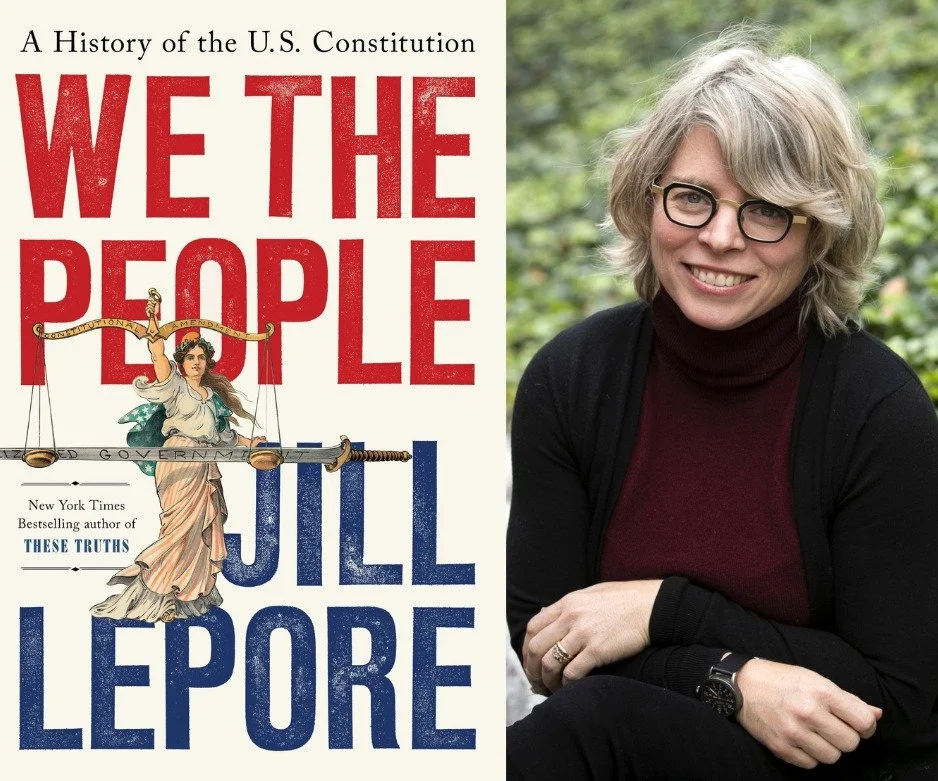
Photo credit: monticello.org
Lepore’s book coincides with the 250th anniversary of the U.S. Constitution. As we know, amending the constitution requires a two-thirds super majority in both Houses of Congress. This high bar has resulted in our having one of the lowest amendment rates of constitutions in the world. Most countries’ constitutions only last 18 years, Lepore stated. A common argument is that our constitution has remained unchanged because it is so good, she said. She thinks that may not be the case. There have been times, “bursts” she called them, when amendments have been called for — notably during the Civil Rights Movement, Reconstruction, and Progressivism. Times when Blacks, women, and native nations met to discuss changes they wanted — "constitutional aspirations.”
Today, our change is coming from the courts and from the Executive Branch rather than from amendments, Lepore stated. Franklin D. Roosevelt did the same thing in the 1930s when he knew he could not get the New Deal through Congress. Today, she explained, the Executive office is declaring, “if I do it, it's constitutional.”
There hasn’t been a Constitutional Convention since 1986, she said. “We’ve lost our skills. This is why studying civil life is so important.” Lepore contends that we need to rebuild our local civil life from the neighborhoods and towns up.
Before ending her presentation with moderator Paul Folgar, Tufts professor of race, emancipation, and slavery, Lepore launched her attack on social media and her wish for the annihilation, admittedly impossible, of cell phones.
She believes it was the "willful acts of social media” that destroyed newspapers and “undermines our ability to live with each other.” Furthermore, “Social media has destroyed our ability to think clearly.” However true that may be, this is undoubtedly a tough argument with Gen Z and Millenials. Moreover, legislative calls for limiting access to social media by youth under 16, such as in California, are running into pushback from free speech advocates.
Maybe these are two of the reasons the audience was skewed as it was. If so, how do we reach the population of young people who could change the world if only they knew how?
Therese (she/her/hers)
Judy (she/her/hers)
Didi (she/her/hers)
Leading Ladies Executive Team