
Can We Save The VRA?
Dear Leading Ladies,
I was 17 and had just graduated high school when President Lyndon Baines Johnson signed the Voting Rights Act in August of 1965. I must have been aware of the event, even watched it on tv. After all, my parents were good liberal white Democrats. They donated to the NAACP and the United Negro College Fund. My mother even taught kindergarten in an all-Black public school. And she and I volunteered to work at the Head Start program when it first opened at a school in the all-black part of our otherwise all-white town. So, yes, I grew up knowing that there was a great divide in our society and some understanding that voting rights were important for people of all colors, faiths, economic strata, and political persuasions. Yet neither my parents nor I, my older brothers nor any of our friends marched with MLK in Selma or Washington or hopped on a bus to Mississippi to register voters. We were all pretty comfortable in our de facto segregated New Jersey suburb that summer of ’65 before I left for college in New England.
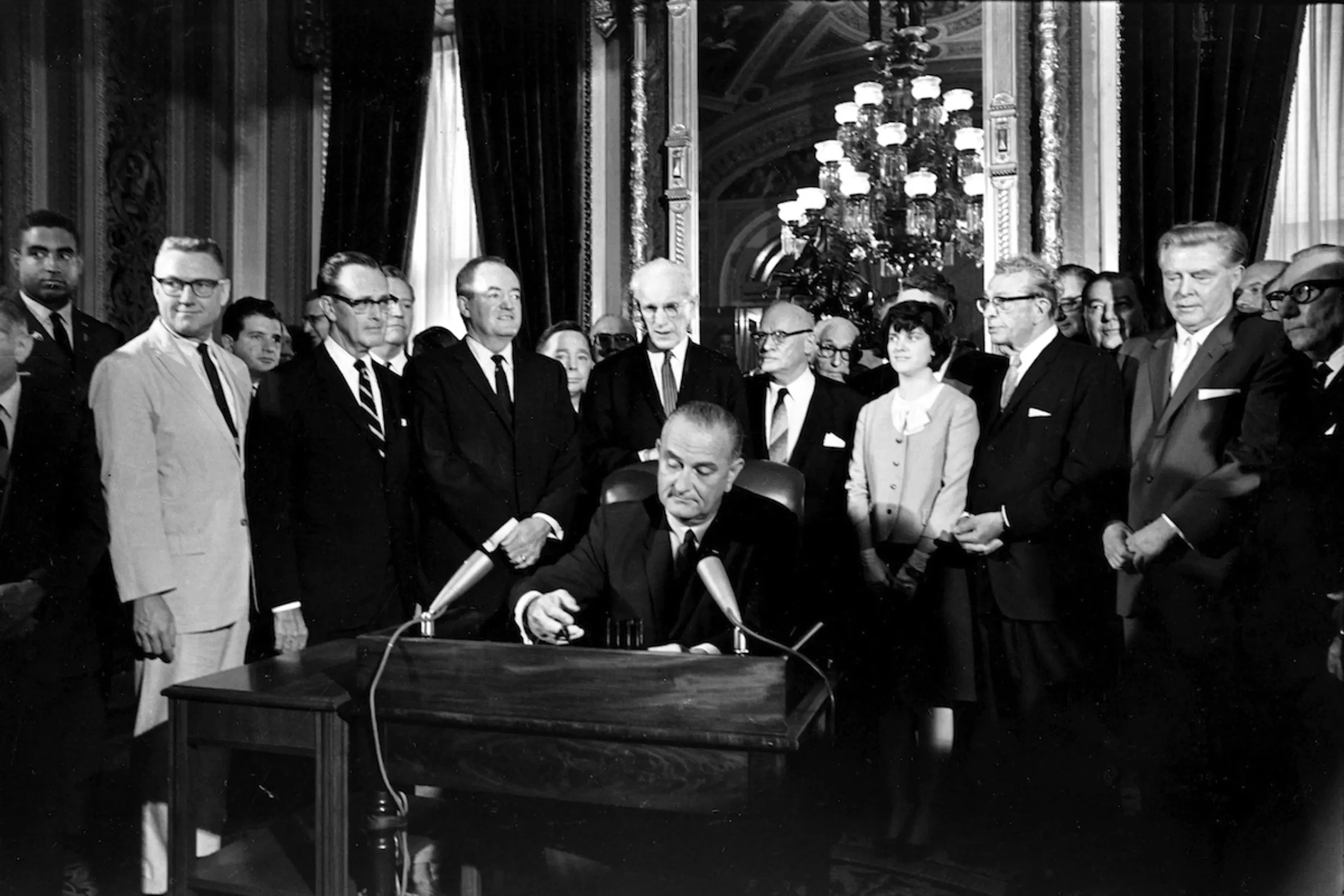
LBJ signing the VRA in 1965. NYTimes.com
But, if we weren’t paying close attention then (or maybe not even alive yet), we need to pay close attention now, to both the history and the current status of voter access and suppression.
Why?
Because the 1965 Voting Rights Act is under siege. The law that promised the whole country — white, Black, rich and poor — the right to participate in elections and be represented by those in office — is on the chopping block.
And because now, unlike from my perch in 1965, I feel in my gut, that when even one of us can’t participate equally in our democracy, we have no democracy. Moreover, I feel compelled to speak up with those and for those who are now in the crosshairs of the avengers.
Viewing the history of voting rights in our country shows how good and bad times have been, providing perspective on how much we have to fear and why.
The first question some people have is, why did we need the Voting Rights Act if we had the Fifteenth Amendment of 1870 that gave African Americans the right to vote? The timeline below should answer that and other questions before we move on to the present crisis. (Information for the timeline came from ACLU.org)
After the Civil War and the Emancipation, the Civil Rights Act of 1866 granted citizenship, but not the right to vote, to all native-born Americans.
Then, in 1869, Congress passed the Fifteenth Amendment, giving African American men the right to vote.
In 1890, however, just 21 years later, Louisiana passed “‘grandfather clauses’ to keep former slaves and their descendants from voting. As a result, registered black voters dropped from 44.8% in 1896 to 4.0% four years later.” Mississippi, South Carolina, Alabama, and Virginia followed suit.
As of 1940, only 3% of eligible African American voters in the South were able to vote, stymied by Jim Crow laws such as literacy tests and poll taxes.
The 24th Amendment was adopted in 1964, outlawing poll taxes.
In 1965, President Lyndon Baines Johnson signed into law the Voting Rights Act (VRA), “permanently barring barriers to political participation by racial and ethnic minorities, prohibiting any election practice that denies the right to vote on account of race, and requiring jurisdictions with a history of discrimination in voting to get federal preclearance for changes in their election laws before they can take effect.” Two hundred and fifty thousand new Black voters are registered by the end of the year.
In 1970, President Richard Nixon signed an extension to the VRA.
In 1975, President Gerald Ford signed an extension to the VRA.
In 1982, President Ronald Reagan signed a 25-year extension to the VRA.
In 2006, Congress extended Section 5 of the VRA for 25 years.
And then, in 2010, the tide started to change. Voter suppression began to rise. Notably, in 2013, in Shelby v Holder, the Supreme Court weakened the VRA by striking down Section 4 which contained a formula used to determine which jurisdictions required federal approval before changing voting laws. This led to “increased voter ID requirements, polling place closures, and racial gerrymandering” that disproportionately affected minority voters, according to the Brennan Center for Justice at NYU School of Law.
The 2014 Voting Rights Amendment repaired some of the damage done by Shelby v Holder, restoring some of the access to voting undone by recent efforts. Then, in 2016, efforts in North Carolina, Kansas, Texas, and North Dakota were also successful in restoring voting rights.
To look a little more closely at a couple of the earlier voting laws, consider the 13th, 14th, and 15th Amendments. According to the National Archives, “To former abolitionists and to the Radical Republicans in Congress who fashioned Reconstruction after the Civil War, the 15th Amendment, enacted in 1870, appeared to signify the fulfillment of all promises to African Americans. Set free by the 13th amendment, with citizenship guaranteed by the 14th Amendment, Black males were given the right to vote by the 15th Amendment.”
All went well through the 1880s until the early 1890s when “steps were taken to ensure subsequent ‘white supremacy’.” Literacy tests for the vote, ‘grandfather clauses’ excluding from the franchise all whose ancestors had not voted in the 1860s, and other devices to disenfranchise African Americans were written into the laws of former Confederate states.”
“Social and economic segregation were added to Black America’s loss of political power. In 1896, the Supreme Court decision Plessy v. Ferguson legalized “separate but equal” facilities for the races. For more than 50 years, the overwhelming majority of African American citizens were reduced to second-class citizenship under the ‘Jim Crow’ segregation system.”
But then, the Civil Rights Movement, with charismatic leadership from figures like Martin Luther King Jr, Rosa Parks, and John Lewis, and the support of Robert Kennedy, President Johnson, and other political leaders, paved the way for the Voting Rights Act. “Regarded as the legislative crown jewel of the civil rights era, the Voting Rights Act was enacted as a comprehensive tool meant to undo the political hold of Jim Crow policies in the South and related discriminatory structures nationwide,” wrote Kareem Crayton of the Brennan Center for Justice recently. “Congress adopted the law to ensure that states followed the 15th Amendment’s guarantee that the right to vote not be denied because of race. The law fundamentally opened political opportunities for Black and brown communities to participate in all aspects of the political system on an equal basis.”
The Act was an insurance policy that was supposed to have no exit doors. “Section 5 of the law requires jurisdictions with a history of discrimination to obtain approval from the Department of Justice or a court before changing voting rules, a process known as ‘preclearance’. Crayton continued, “Section 2 of the law allows people to sue — either on their own behalf or with the assistance of the Justice Department — to undo existing laws and procedures that would deny equal political opportunity to voters to elect their candidates of choice.”
Only the insurance policy started to spring some leaks. The 2013 Shelby v Holder decision mentioned earlier eliminated the need for states to get federal preclearance for new voting rules, and the 2021 Supreme Court’s ruling in Brnovich v. Democratic National Committee that made it harder to bring lawsuits under Section 2 set the stage for last week’s Supreme Court ruling in Louisiana v Callais.
In simple terms, according to Geoff Bennett of PBS NewsHour, “In a 6-3 ruling Wednesday [April 29, 2026], the U.S. Supreme Court’s conservative majority struck down one of Louisiana’s majority-Black congressional districts. The decision weakens key protections under the Voting Rights Act and could open the door to broader legal challenges over majority-Black and Latino districts nationwide. Writing for the majority, Justice Samuel Alito called the map an unconstitutional gerrymander. The decision could open the door to broader legal challenges over majority Black and Latino districts across the country and give states new latitude to redraw maps in ways that could shift the balance of political power.” (Source)
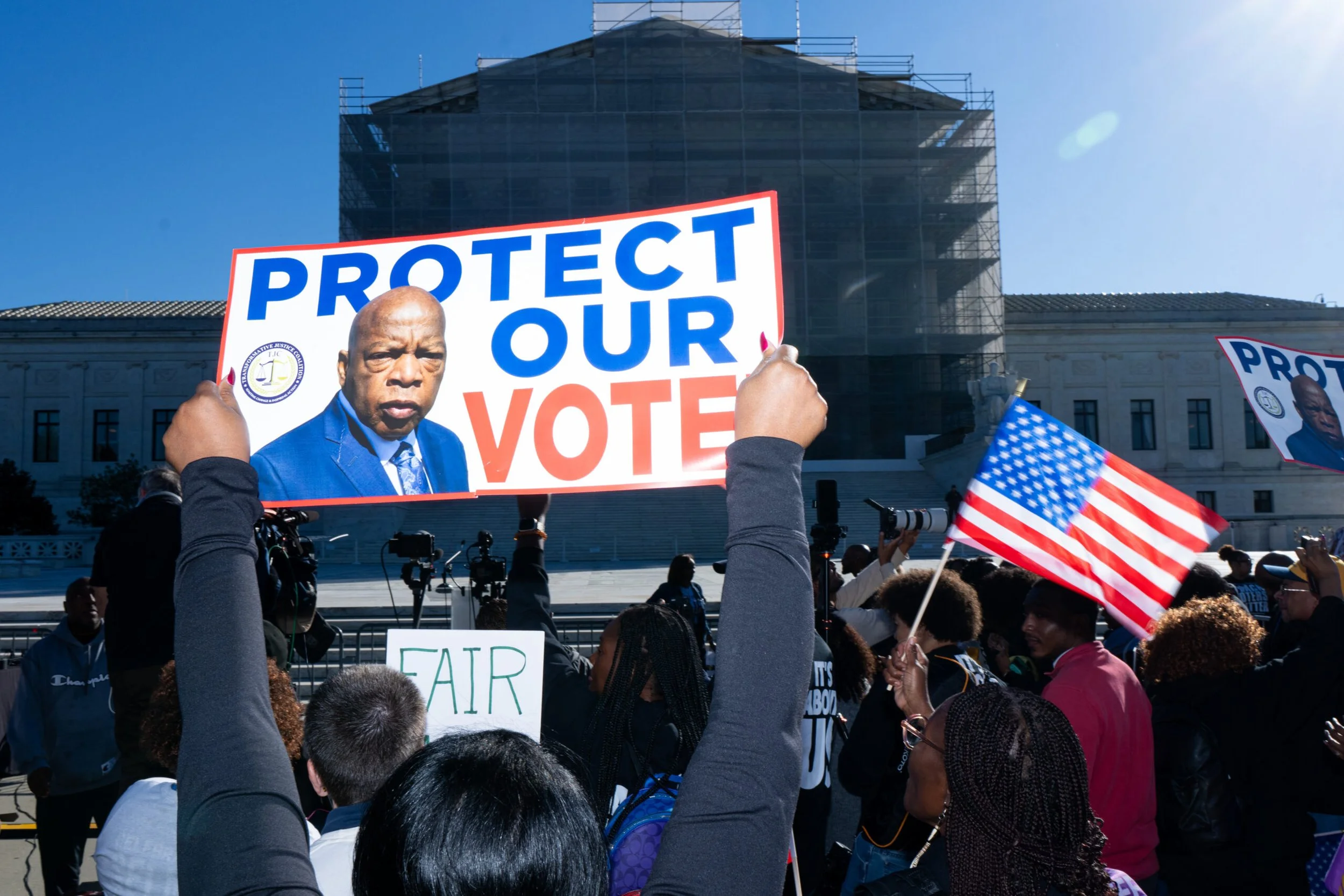
Protest after SCOTUS blow to VRA. Rollingstone.com
Essentially, the court has now opened the door for the destruction of districts that are primarily Black and likely to elect Black local, state, and federal politicians. These residents will lose their voices in government. Progress made since 1965 is in jeopardy. As Joan Biskupic of CNN put it, “Taken as a whole, the pattern would mean fewer chances for minority voters to elect candidates of their choosing. That, in turn, would mean fewer opportunities for the voice of Blacks, Latinos, Native Americans and other minorities in government.”
Critics may say that districts that represent one race is reverse racism. That argument seems unreasonable when the preponderance of districts are majority white. While the primarily Black districts may be described as created by gerrymandering, their intent and result is to provide representation for the Black population that they would not otherwise have. Is that not creating equity and both the intent of the constitution and the VRA?
Biskopic refers to Justice Elena Kagan’s thoughts and remarks. “This court’s project to destroy the Voting Rights Act is now complete,” she said. “It was born of the literal blood of Union soldiers and civil rights marchers…“For over a decade, this court has set its sights on the Voting Rights Act.” Justice Kagan concluded that with what she described as the court’s “made-up and impossible-to-meet evidentiary standards,” the decision “greenlights districting plans” that would disadvantage minorities nationwide.
Is all hope lost? The prospects may look bleak. “However, the Court is not the final say on the matter,” according to the Brennan Center. Congress has specific authority under the 15th Amendment to craft necessary legislation to safeguard the right to vote absent race discrimination. Accordingly, a new law that adequately protects the right to vote for every citizen is well in order. The record supporting such a law would press the Supreme Court to respect a new and well-grounded congressional response to a present and clear need for federal oversight of our election system.”
Andrea Cabral, former secretary of safety and security for the Commonwealth of Massachusetts, is not as confident. Speaking on Boston Public Radio/GBH last week, she said, “This is the most significant entrenchment of white supremacy since Jim Crow…Louisiana is now postponing its primary elections, which creates chaos and confusion. Now they can invalidate the results if they don’t like them. They are intentional and deliberate in making this decision.”
Her words became more vitriolic the longer she spoke. “Make no mistake. This isn't a question about ignorance or blind optimism about the human condition. They [the majority Supreme Justices and the current administration] are all well aware of [what is happening] in the United States of America. I would suggest that Alito and Roberts are racist. They are themselves racist whether they want to acknowledge that or not. Clarence Thomas has benefited from all of the suffering and the death and blood and the tears of the fight that came about to create civil rights laws and civil rights equality under the law for all people. An absolute beneficiary. And here he stands as he stood with Scalia before Scalia died, walks in lockstep with Roberts and Alito now on all of these things. He is, for his own special reasons, among the most disgraceful.”
Cabral believes that the president and his men are moving forward with their goals of white supremacy “without any regard to the legacy of the Supreme Court, to the Constitution or democracy.” She says she is “at the point where I believe their intent is to overturn democracy because it does not continue to benefit solely white straight men. These are white supremacist rulings. This is a president who is a white supremacist. I don’t know how people can not get this or fail to embrace it and fight back with everything they’ve got… Because this is how democracy ends.”
We stand warned. This latest Supreme Court decision is no one-off. There are more to come.
What will I do this time? I want it to be more than I did at 17. How ’bout you?
Some organizations working to support voting rights are the Southern Coalition for Social Justice; the Legal Defense Fund; and the Southern Poverty Law Center. Also, donate to campaigns of candidates for Congress who will fight any changes to the Voting Rights Act that will negatively impact the ability of voters to register to vote and to vote. A group we have just learned about is the States Project, dedicated to win states in November that “will determine who draws the maps, and gets to vote, and whether their votes count in 2028 and beyond.” Check them out.
Judy (she/her/hers)
Therese (she/her/hers)
Didi (she/her/hers)
Leading Ladies Executive Team
Leadingladiesvote.org
ladies@leadingladiesvote.org