
Dear Leading Ladies,
Outside the Smithsonian National Museum of American History in Washington, DC, President Trump plans to install signs on federal walkways that will declare that the displays inside the museum support “extreme political activism.” The signs will direct people to exhibits where history is more accurately presented, he promises. The president’s order for the signage followed the release of a 102-page report that accused the Smithsonian of “radical activist ideology” and undermining “faith in American institutions.” While the signs had yet to be put in place as of our sending this letter, we expect to see them soon.
Anthea M. Hartig, director of the museum and a frequent target of the president, was recently “grilled by Republican legislators in two congressional hearings where she was accused of teaching ‘national self-loathing,” according to the New York Times.
Her response? “When historians talk about reframing a traditional narrative, we don’t mean erasing it,” she testified. “We mean adding the evidence, the voices, the objects that earlier telling left out so that more Americans can see themselves reflected in the national story.”
It is worth mentioning that the Smithsonian was founded with a sizeable bequest from Englishman James Smithsonian, a chemist and mineralogist who left a very hefty sum to the United States “to found at Washington, under the name of the Smithsonian Institution, an establishment for the increase and diffusion of knowledge among men.” This would only happen after the death of Smithsonian’s nephew and if the nephew had no heirs of his own. That occurred in 1835.
In 1846, then, Congress passed the legislation to found the Smithsonian Institution according to the donor’s wishes, but not without some controversy over states’ rights between federalists and their foes. The Smithsonian was created “as a federal establishment, not part of the three branches of government, managed by a self-perpetuating Board of Regents,” as is explained on its website. The secretary of the Smithsonian is its chief executive officer. While the president is not supposed to have authority over the Smithsonian, the vice president, the Chief Justice, three senators, and three representatives are among the 17 regents. As the president tries to change the character and messaging of a variety of other institutions and sites, there is clearly potential for that occurring at the Smithsonian as well.
But I digress.
Just as Trump was accusing the Smithsonian of rewriting history (while, in fact, trying to erase the truth of the past himself), a little known writer, historian, and reverend was performing her own act of historic preservation in Colorado.
And I use the word performing purposely.
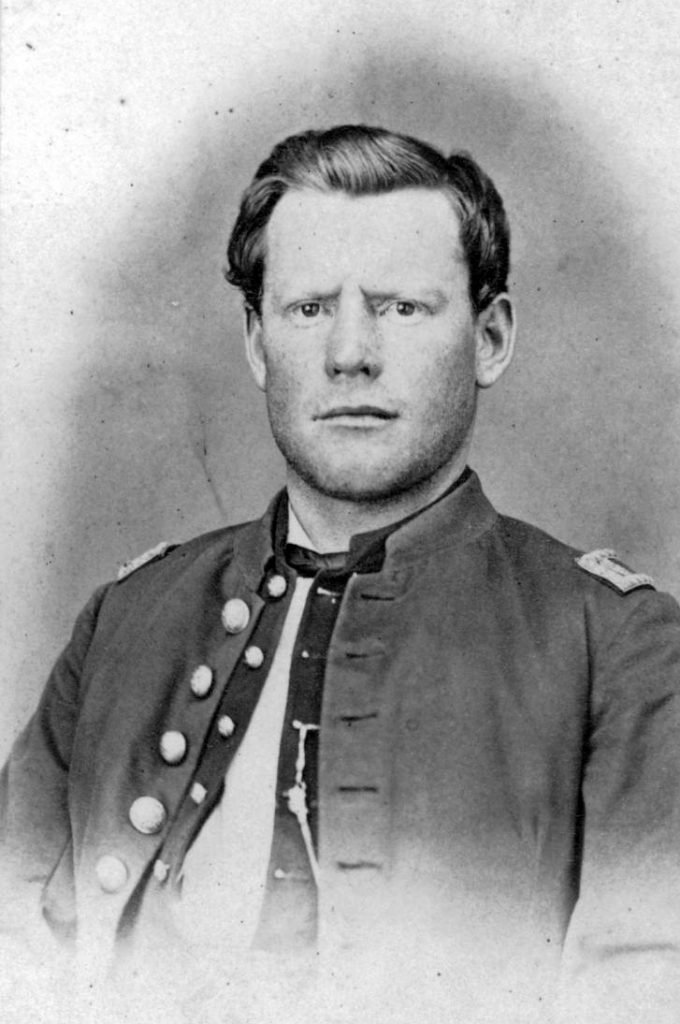
Every July, Rev. Nancy Niero honors Captain Silas Soule by reading the letters he wrote home about the horrors he witnessed at the massacre at Sand Creek in 1864. Nero stands by Soule’s gravesite in Denver, with an audience of anywhere from two to several dozen, everyone from young families to teachers and history buffs. As the listeners surround her, Niero honors the courage and integrity of the young soldier who stood up for the truth while his superiors ordered the murder of a peaceful encampment of Arapaho and Cheyenne elders, women and children. He defied the order and later testified to Congress about the massacre his superiors falsely claimed was a battle, speaking truth to power. Soule, who died at 26, had been an abolitionist and was active in the Underground Railroad before joining the US Volunteer Cavalry (Union soldiers, to be clear).
Captain Silas Soule is the kind of hero we need more of today and Nancy Niero is the kind of storyteller we need to spread tales of courage and bravery that inspire. For more about them both, read Niero’s recent book, Massacre at Sand Creek. It includes Soule’s letters, just in case you can’t make it to her reading next July. But, if you are in the area, there’s also a monument recalling the massacre on the Eastern Plains outside Denver.
We still believe that standing up and bearing witness can make a difference.
Therese (she/her/hers)
Judy (she/her/hers)
Didi (she/her/hers)
Leading Ladies Executive Team