
Dear Leading Ladies,
I set a personal goal to see our national parks. All 64 of them. I was inspired by an Ansel Adams exhibit at the Boston Museum of Fine Arts in 2019. Adams captured Yosemite National Park in black and white, and it was breathtaking.
Thus far, I’ve visited 23 of these parks and they are spectacular. Vast, wild, pure. I’ve witnessed sunrise at the most eastern point in the continental U.S. (Cadillac Mountain, Acadia National Park, Maine). I was dwarfed by the General Sherman tree, the largest single stem tree on Earth (Sequoia National Park, CA). And I stood 282 feet below sea level in Bad Water Basin (Death Valley National Park, CA). The mountains, rivers and lakes all formed hundreds of millions of years ago. These experiences confirm, for me, the power of nature and my place within it.
I am grateful that I live in a place of such diverse and contrasting beauty.
As I began my quest, I wanted to first understand the difference between national parks and national monuments. In short, national monuments (which can vary in size from a single statue to large tracts of land) can be established only by Presidential or Congressional declaration through the Antiquities Act of 1906. National Parks are determined by Congressional action and managed by the National Parks Service. The parks focus on safeguarding large ecosystems, wilderness areas and scenic features of significance.
For thousands of years, indigenous Americans cared for lands now designated as national parks and monuments. These lands were and continue to be sacred to them. They are the experts, drawing on 10,000+ years—that’s 500 generations—of ancestral knowledge. We were disappointed to learn that they continue to co-manage only a small number of national monuments and no national parks today.
For example, Bears Ears National Monument in Utah, 1.35 million acres, was established in 2016. Beginning in 2022, it was co-managed by the National Park Service and the Forest Service in collaboration with the Five Nations. In 2026, however, President Trump acted to reduce the size of the monument and change the governance. According to The Emancipator, “Trump has removed more land from federal protected monument status than any president.” Trump has expressed the desire to use that land for drilling, mining and development.
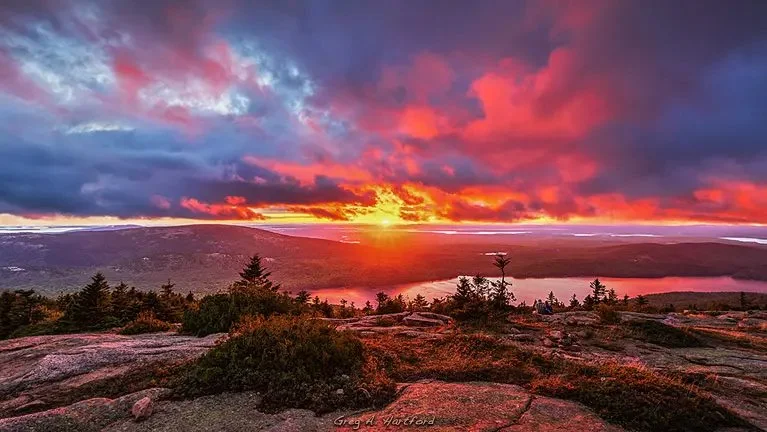
Sunrise Cadillac Mountain, Acadia National Park, acadia.ws
As for national parks, all of them “exist on traditional Indigenous lands, and in many cases, thousands of years’ worth of Native American history has been documented at national park sites,” according to the National Parks Conservation Commission. “Decades’ long tensions and struggles continue over Indigenous access to sacred sites within national parks, along with issues including inaccurate or inappropriately named places and educational information. Amid struggles, progress continues.” In 1902, when President Teddy Roosevelt established the national parks, he ensured the protection of land and wildlife for future generations, but he further disenfranchised Native Americans.
Activist Qwatsinas (Hereditary Chief Edward Moody) of the Nuxalk Nation wrote to his people, probably in the 1990s, “We must protect the forests for our children, grandchildren, and the children yet to be born.” In 1903, Teddy Roosevelt is quoted as exhorting Americans to cherish the country’s land, natural wonders, natural resources, history and romance as a sacred heritage for future generations, and not allow selfish interests “to skin your country” of its beauty, its riches and its romance. Was he addressing Native Americans as well as other Americans in his remarks? I think we know.
I am grateful for Teddy Roosevelt's vision, though it may have ignored the territorial rights of Native Americans. He did, nonetheless, protect land that might otherwise have been privatized and developed into God knows what. I am gravely sorry for all that was stolen from those first Americans to whom the land belongs and is still sacred. And I am fearful for what reckless leaders may try to do to drill or build or destroy these places of beauty and history. Because when they are gone, there will be no more.
This Thanksgiving, we can be grateful for the wide open spaces that were saved for all of us to enjoy in perpetuity. Let’s not let the situation get any worse, but rather join the efforts to make it better.
These organizations are fighting to preserve sacred land. We can fight with them.
Therese (she/her/hers)
Judy (she/her/hers)
Didi (she/her/hers)
Sarah (she/her/hers)
Leading Ladies Executive Team
Leadingladiesvote.org
ladies@leadingladiesvote.org